

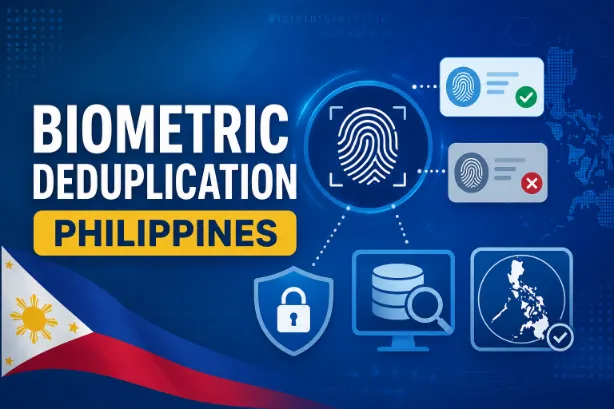
Biometric deduplication Philippines refers to the use of biometric technology to determine whether a person is already registered in a database, even if the person attempts to enroll again using a different name, account, or identity record. The process commonly uses fingerprints, facial characteristics, iris patterns, or other measurable biological traits to detect duplicate identities.
The concept is especially relevant to identity management, government services, financial institutions, workforce systems, healthcare, border management, and other applications where an organization needs confidence that one individual is not creating multiple identities.
In technical terms, deduplication is generally a one-to-many (1:N) biometric search. A newly collected biometric sample is compared against many existing records to determine whether a sufficiently similar record already exists. NIST’s current Digital Identity Guidelines specifically recognize 1:N biometric identification for identity resolution and deduplication, while also emphasizing privacy risk assessment and safeguards against false matches.
What Is Biometric Deduplication?
Biometric deduplication is a process for finding duplicate enrollments in a biometric database.
A traditional identity check may ask:
“Does this fingerprint or face belong to the person claiming this identity?”
That is a 1:1 verification process.
Deduplication asks a different question:
“Does this biometric already exist anywhere in the database?”
That is a 1:N identification process.
For example, suppose a service provider has 500,000 registered individuals. A new applicant provides a fingerprint or facial image. The system converts the biometric sample into a mathematical representation and searches the existing biometric records. If the similarity score exceeds the configured threshold for an existing record, the system can flag the enrollment for investigation.
The automated result should not automatically be treated as proof of fraud. NIST’s current guidance recommends manual review before declining enrollment based on a 1:N deduplication result because a false positive can occur.
How Biometric Deduplication Works in the Philippines
A typical biometric deduplication workflow contains several stages.
1. Biometric Capture
The individual provides a biometric sample through an approved sensor or camera.
Depending on the application, this may involve:
- Fingerprints
- Facial images
- Iris patterns
- Palm or other biometric characteristics
The quality of the captured sample is important. Poor lighting, an unsuitable camera angle, damaged fingerprints, motion, or other capture problems can reduce matching reliability.
2. Quality Assessment
- The system evaluates whether the sample is suitable for matching.
A low-quality biometric sample can create two types of problems. It may fail to match the legitimate person’s existing record, or it may produce unreliable comparison results.
3. Template Generation
- Many biometric systems do not perform database searches by simply comparing raw images. Instead, software extracts measurable characteristics and generates a biometric template or other mathematical representation.
The exact technology depends on the biometric modality and system design.
4. One-to-Many Search
- The new biometric template is searched against the existing database.
This is the central stage of deduplication. The objective is to identify possible existing records associated with the same individual.
5. Similarity Scoring
- The biometric engine produces comparison scores. A configured threshold determines whether a result is sufficiently strong to become a potential match.
NIST explains that biometric systems must balance false matches and false non-matches. A false match occurs when the system incorrectly treats two different people as the same person, while a false non-match occurs when the system fails to match samples belonging to the same individual.
6. Human Review
- A potential duplicate should normally be reviewed before an adverse decision is made.
This step is important because biometric matching is probabilistic rather than an infallible declaration of identity. NIST’s current guidance specifically calls for manual review of automated 1:N deduplication results before an applicant is rejected.
Why Biometric Deduplication Matters
Duplicate identity records can create operational, financial, and security problems.
A person might accidentally be registered twice because of incomplete records, a change in personal information, or inconsistent enrollment procedures. More serious situations may involve deliberate attempts to create multiple accounts or obtain benefits more than once.
A well-designed deduplication system can help organizations:
- Detect duplicate registrations
- Improve identity record quality
- Reduce certain forms of identity fraud
- Support more reliable identity databases
- Prevent unnecessary duplicate accounts
- Improve the integrity of enrollment programs
- Assist identity resolution across records
The value of the technology depends heavily on the quality of the biometric system, enrollment process, database design, review procedures, and privacy controls.
Biometric Deduplication and the Philippine Data Privacy Act
Privacy is a central consideration for biometric deduplication in the Philippines.
The Data Privacy Act of 2012 (Republic Act No. 10173) governs the processing of personal information in the Philippines. It establishes principles including transparency, legitimate purpose, proportionality, security, and accountability.
The National Privacy Commission has also stated in a 2025 advisory that biometric data processing remains subject to the Data Privacy Act, its implementing rules, and relevant NPC issuances. The NPC noted that it had not yet issued a dedicated set of guidelines specifically governing biometric data at the time of that advisory.
This means organizations should not treat biometric deduplication as simply an IT implementation. The privacy implications need to be addressed as part of the overall project.
Key Philippine Privacy Principles for Deduplication
Transparency
People should receive appropriate information about how their personal data is processed.
The Data Privacy Act and its implementing rules require information about matters such as the purposes of processing, the scope and method of processing, recipients, storage periods, and data-subject rights, subject to applicable exceptions.
Legitimate Purpose
An organization should have a clear and lawful reason for collecting and using biometric information.
A deduplication system should not collect biometric information simply because the technology is available. The purpose should be identified and declared.
Proportionality
The amount and type of information collected should be appropriate for the intended purpose.
The NPC’s implementing rules describe proportionality as processing that is adequate, relevant, suitable, necessary, and not excessive in relation to the declared purpose.
Security
Biometric information requires strong technical, physical, and organizational safeguards.
The Data Privacy Act requires personal information controllers to implement reasonable and appropriate safeguards against unlawful access, alteration, disclosure, destruction, and other unauthorized processing.
Retention
Organizations should avoid retaining personal data indefinitely without a lawful reason.
Retention should correspond to the purpose for which the information was collected, applicable legal requirements, and legitimate organizational needs.
Privacy Impact Assessment for Biometric Deduplication
A Privacy Impact Assessment (PIA) can be particularly important for a biometric deduplication project because the system processes information that can have significant consequences for individuals.
The National Privacy Commission describes a PIA as a process for identifying and managing privacy impacts associated with programs, systems, technologies, devices, and other initiatives involving personal information.
For government agencies, NPC Circular 16-01 historically required PIAs for programs involving personal data and described assessment of processing operations, necessity, proportionality, and risks to data subjects. The NPC has since replaced that circular with updated security requirements under NPC Circular 2023-06.
A biometric deduplication PIA can examine questions such as:
- What biometric data is collected?
- Why is deduplication necessary?
- Who can access the biometric database?
- How long will biometric information be retained?
- What happens after a potential duplicate is detected?
- Can a person challenge a suspected duplicate?
- What safeguards protect biometric templates?
- Are third-party processors involved?
- What happens if the system produces a false match?
- How are security incidents handled?
Accuracy Is Critical
A biometric deduplication system should be evaluated using measurable performance standards rather than marketing claims.
Two important concepts are false match rate and false non-match rate.
A false match can be particularly serious in deduplication because the system might incorrectly associate one person’s biometric data with another person’s record.
A false non-match creates a different problem: an actual duplicate may go undetected.
NIST’s current Digital Identity Guidelines specify performance requirements for certain 1:N identity-resolution and deduplication applications and require testing against operationally relevant database sizes. They also emphasize demographic performance testing.
Organizations evaluating biometric deduplication should therefore examine independent testing, population coverage, database size, biometric modality, environmental conditions, and error rates rather than relying solely on a vendor’s headline accuracy percentage.
Common Applications in the Philippines
Biometric deduplication can have applications across multiple sectors.
Government Identity Programs
- Large identity programs may need to ensure that individuals do not create multiple registrations.
The Philippine Identification System (PhilSys), for example, was designed to provide a foundational proof of identity for Filipinos and resident aliens. The Philippine Statistics Authority has described privacy and security measures surrounding PhilSys, including a PhilSys Data Privacy Manual, data governance framework, Privacy Impact Assessment activities, and designated Data Privacy Officers.
Banking and Financial Services
- Financial institutions may use biometric technologies as part of identity verification and fraud-prevention processes. Any such implementation must account for applicable privacy, financial-sector, security, and regulatory requirements.
Employee and Workforce Systems
- Organizations may use biometric authentication for attendance or access control. Deduplication can help prevent multiple registrations in systems where one individual should have only one authorized identity.
Healthcare
- Biometric identification can assist with patient identity management, although healthcare applications require careful consideration of privacy, accuracy, access controls, and applicable health-data obligations.
Education and Examination Systems
- Biometric systems may help establish that a registered person is the same person accessing a service, examination, or account. The necessity and proportionality of collecting biometric information should be assessed for each use case.
Challenges of Biometric Deduplication
Biometric deduplication offers useful capabilities, but it is not risk-free.
False Positives
- Two different people can produce sufficiently similar biometric measurements for an algorithm to flag them as a potential match.
A false positive can cause delays, additional verification requirements, or an incorrect denial of enrollment.
False Negatives
- A duplicate registration can escape detection because the biometric sample is poor or the matching threshold does not identify the existing record.
Changing Biometric Conditions
- Some biometric characteristics can be affected by age, injuries, environmental conditions, image quality, or changes in capture equipment.
Database Scale
- A 1:N search becomes more demanding as the database grows. System architecture, indexing, matching algorithms, hardware, and operational procedures all affect performance.
Privacy and Security Risks
- A biometric database can create substantial privacy risks if improperly accessed, copied, disclosed, or retained.
For this reason, organizations should treat biometric security as part of their broader data-protection program rather than as a standalone software feature.
Best Practices for Choosing a Biometric Deduplication System
Organizations considering biometric deduplication Philippines should evaluate the complete system rather than focusing only on the matching algorithm.
Important evaluation areas include:
- Accuracy testing — Review false-match and false-non-match performance.
- Population testing — Check performance across relevant demographic groups.
- Database scalability — Test against the expected operational database size.
- Human review — Establish a process for investigating possible duplicates.
- Privacy assessment — Conduct an appropriate PIA before deployment.
- Purpose limitation — Define exactly why biometric information is being processed.
- Security controls — Protect biometric data through appropriate organizational, physical, and technical safeguards.
- Retention rules — Establish documented retention and deletion procedures.
- Access controls — Restrict biometric information to authorized personnel and systems.
- Vendor accountability — Establish appropriate contractual and security requirements for personal information processors.
The NPC’s compliance materials emphasize privacy risk assessment, appropriate safeguards, accountability, and ongoing management of personal-data processing.
Biometric Deduplication Philippines: What Organizations Should Remember
Biometric deduplication is more than a method for matching fingerprints or faces. It is an identity-management process that combines biometric science, database technology, security controls, operational review, and privacy governance.
In the Philippines, organizations using this technology should consider the Data Privacy Act of 2012, its implementing rules, and applicable National Privacy Commission issuances. The NPC has specifically confirmed that biometric data remains subject to Philippine data-protection requirements, while specialized biometric guidance continues to develop.
The strongest approach is to design deduplication around accuracy, necessity, transparency, proportionality, security, and human oversight. A system should flag potential duplicates for appropriate review rather than treating an automated similarity result as unquestionable proof of identity.
For organizations planning deployment, the combination of a properly evaluated biometric engine, strong enrollment procedures, privacy impact assessment, secure data architecture, documented retention rules, and effective manual review provides a more responsible foundation for biometric deduplication in the Philippines.
What does biometric deduplication mean?
Biometric deduplication is the process of comparing a person’s biometric information against an existing database to determine whether that individual may already have a registered identity.
Is biometric deduplication legal in the Philippines?
Biometric processing can be lawful, but organizations must comply with applicable Philippine privacy laws and regulations. The Data Privacy Act requires a lawful basis and adherence to principles such as transparency, legitimate purpose, proportionality, and security.
What is 1:N biometric matching?
1:N matching compares one person’s biometric sample against multiple records in a database. It is commonly used for identification, identity resolution, and deduplication.
Can biometric deduplication make mistakes?
Yes. Biometric systems can produce false matches and false non-matches. That is why performance testing and human review are important, particularly for decisions affecting enrollment or access.
Does biometric deduplication require a Privacy Impact Assessment?
A PIA is an important privacy-risk management tool for systems processing personal data. Philippine privacy guidance emphasizes assessing necessity, proportionality, processing risks, and safeguards for relevant projects. Specific obligations can depend on the organization and processing activity.
Which biometrics can be used for deduplication?
Depending on the system, deduplication may use fingerprints, facial characteristics, iris patterns, or other biometric modalities. The appropriate choice depends on the use case, population, environment, accuracy requirements, and privacy and security considerations.
